
The Indian rupee has been losing value against the US dollar for most of its post-independence history. What is unusual about the current episode is its speed: the rupee fell from approximately ₹85 per dollar in mid-2025 to an all-time low of ₹96.56 in May 2026, a depreciation of over 13% in less than a year.
This article argues that the crisis is not the product of a single event. It covers the journey of how the rupee ultimately became as unstable as it is today in four distinct phases, and how three overlapping drivers — a structural trade deficit, global cyclical pressures from high US interest rates and trade tariffs, and the outbreak of the US–Iran war in February 2026 — combined to produce this instability. The paper examines each of these causes before turning to their consequences: rising inflation, corporate debt stress, pressure on the RBI, and the divergent impact across sectors of the Indian economy.
Part 01The Rupee's Journey from Weakness to Crisis
The graph of the Indian rupee has been snaking sharply downward. The rupee-to-dollar exchange rate crossed 96 in May this year. The Hindu
That rate stood at approximately ₹85 just a year ago. A fall of 11 rupees in twelve months is what has shifted this from a recurring concern into a full-scale crisis. To understand how this happened, it is useful to look at the depreciation in four distinct phases.
Phase 1: Chronic but Managed Decline (Pre-2024)
For several years prior to 2024, the rupee drifted gradually from ₹74 to ₹83 per dollar. The decline was slow and orderly, largely absorbed by markets without significant concern. The RBI actively managed volatility using its foreign exchange reserves, and since the underlying economic fundamentals remained stable, this period was not considered a crisis by most observers.
Phase 2: Stress Begins (Late 2024 – Early 2025)
By late December 2024, the rupee had reached a record low of ₹85.53, recording its worst single-day fall in nearly seven months and declining across eight consecutive trading sessions. The primary drivers were dollar strength following a hawkish US Federal Reserve stance, concerns about India's slowing growth, and a widening trade deficit. This was a period of controlled stress rather than a crisis.
Phase 3: Pressure Mounts (2025)
The rupee breached ₹91 per dollar in December 2025, moving from 90 to 91 in just nine trading sessions and becoming the worst-performing Asian currency of the year with a depreciation of 5.95%. At this point, the pace of the decline — not just the level — began to attract serious concern.
Phase 4: Crisis Territory (February – May 2026)
The outbreak of the US–Iran war in late February 2026 marked a turning point. The rupee crossed ₹90 in late February, surpassed ₹95 for the first time by the end of March, and crossed ₹96 for the first time in history in May 2026. Having opened the year at approximately ₹89.50–89.90 per dollar, the rupee hit record lows every month between January and May, eventually reaching an all-time low of ₹96.56 on 19 May 2026 — a 7.04% depreciation in just five months.
Part 02What Caused the Rupee Depreciation?
Rupee depreciation is not the result of any single event. As the timeline above shows, the problem has been developing over an extended period. Three distinct but interconnected drivers — structural, cyclical, and a short-term external shock — combined to produce this year's crisis.
Driver 1: Structural and Long-Standing Problems
The most fundamental driver is structural. India's rupee has been on a long-run downward trend against the dollar since independence. Business Standard documented that the rupee was at par with the US dollar in 1947 and had declined to ₹61.80 by 2013 — a fall of nearly 62 times over 66 years. The primary reason is that India's growth model is heavily import-dependent.
This import dependence operates across three areas. Crude oil and petroleum products constitute the largest share of India's import basket, supporting transportation and industrial production nationwide. In addition, a significant portion of machinery, electronic components, and semiconductors are sourced internationally, as domestic manufacturing does not yet have the capacity to produce these inputs at the required scale. India's own export industries — pharmaceuticals, engineering goods, and chemicals — also rely on imported intermediate inputs for production.
The implication is that as India's domestic production grows, demand for imports rises in parallel. Greater import demand increases the need for foreign exchange, which exerts persistent downward pressure on the rupee. India has maintained a negative trade balance for almost its entire post-independence history, with the sole exceptions being 1972–73 and 1976–77. This structural deficit is not new. What determines whether it causes exchange rate instability is whether other parts of the balance of payments can compensate for it.
Driver 2: Global Cyclical Pressures
On top of India's structural vulnerabilities, two global developments intensified pressure on the rupee from 2024 onwards.
First, persistently high US interest rates strengthened the dollar broadly, putting downward pressure on emerging market currencies across the board. IMF data shows that emerging market currencies fell by approximately 4% year-to-date against the US dollar, with Asian emerging markets including India, Indonesia, Thailand, Malaysia, and the Philippines recording similar declines. The key factor was the interest rate differential between these economies and the United States: countries where this gap shrank the most experienced the largest depreciations.
Second, US tariffs on Indian goods directly reduced export revenues. President Trump announced an initial 25% reciprocal tariff on Indian goods on 30 July 2025, effective 7 August. On 6 August, he signed an executive order doubling duties to 50% as a penalty for India's continued purchase of Russian oil, taking effect on 27 August. These tariffs increased the cost of Indian exports, reduced export revenue, and widened the trade deficit. The resulting uncertainty prompted Foreign Portfolio Investors (FPIs) to withdraw capital from India, with net FPI outflows exceeding $18 billion in 2025 alone.
Driver 3: The Trigger — The US–Iran War
While the first two drivers created the conditions for instability, the US–Iran war in February 2026 was the event that converted existing vulnerabilities into an acute crisis. The closure of the Strait of Hormuz — the narrow waterway between Iran and Oman through which approximately 20% of the world's oil supply transits, including most of India's Middle Eastern imports — caused a significant supply shock that drove oil prices sharply higher.
India responded by raising fuel prices by approximately 3%, with petrol rising to ₹97.77 per litre and diesel to ₹90.67. The more significant impact, however, came through the balance of payments. Higher oil prices increased India's import bill, widening the current account deficit at a time when capital inflows were already declining. Foreign portfolio investors, facing currency losses on their Indian holdings amid deteriorating global risk sentiment, accelerated their exit from Indian markets.
To understand why FPIs face currency losses when the current account deficit widens, it is important to trace the mechanism. When an FPI invests in India, dollars are converted to rupees at the prevailing exchange rate to purchase Indian stocks or bonds. The investment is denominated in rupees, but returns will eventually need to be repatriated in dollars. If the rupee has depreciated over the holding period, the dollar value of those returns falls even if the rupee value of the portfolio is unchanged. A widening current account deficit signals further depreciation ahead, which makes exiting the position a rational response.
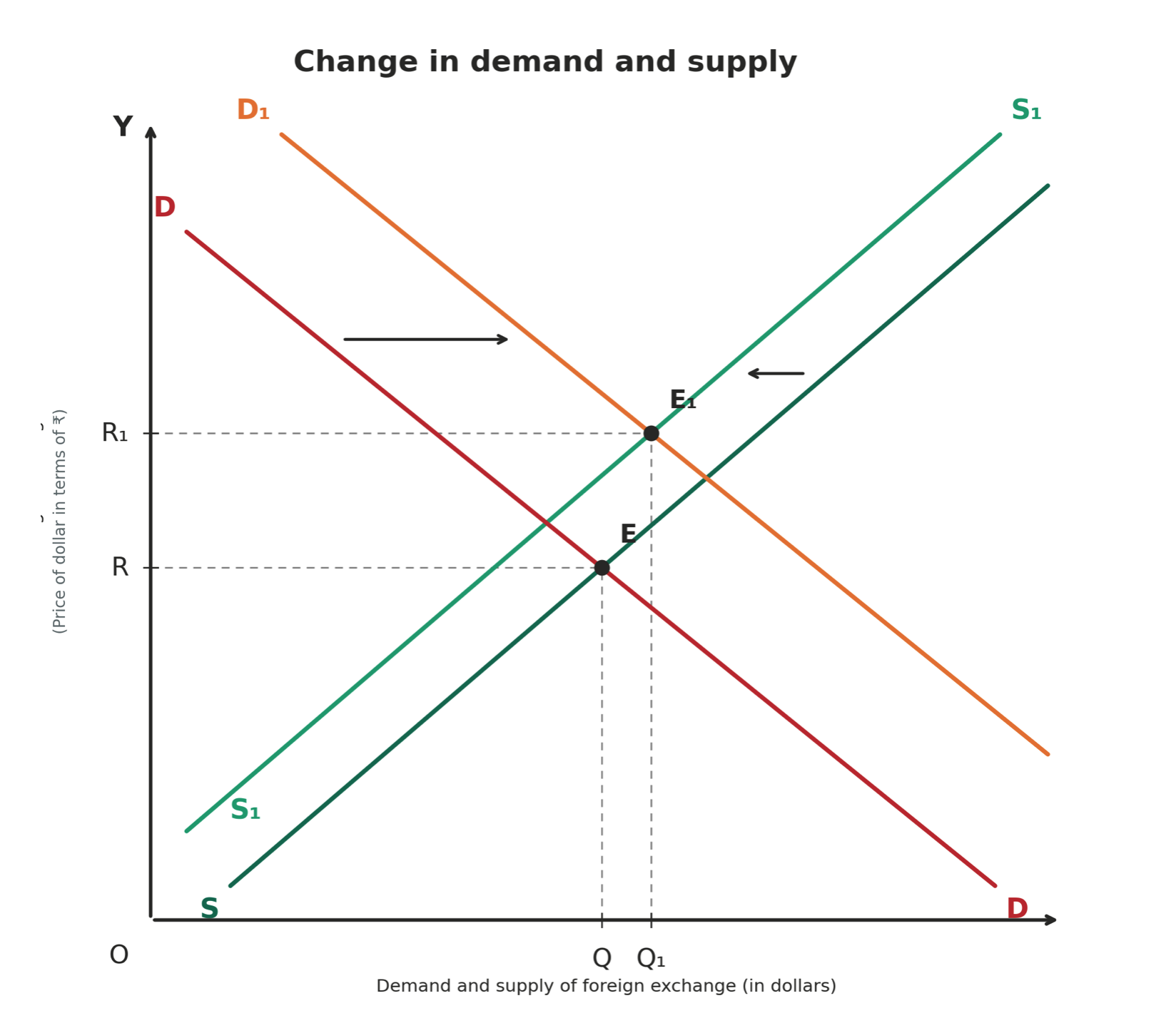
Historically, India's current account deficit was offset by larger capital inflows (FDI and FPI combined), producing a balance of payments surplus that supported exchange rate stability. That position has now changed: a large and growing current account deficit is being met by declining capital inflows. The result is balance of payments stress, where India is paying out more foreign exchange than it is receiving — demand for dollars increases but supply does not, leading to rupee depreciation.
Part 03Impact of Rupee Depreciation
Inflation
The most immediate consequence of the rupee falling past ₹95 has been a rise in imported inflation. The impact has been most severe in energy: WPI inflation for fuel and power reached 24.71% in April 2026, up from 1.05% in March. Crude petroleum and natural gas prices rose 67.18% year-on-year, with crude petroleum alone rising 88.06%. Retail fuel prices increased more moderately to 4.46% on the consumer index, as state-run oil companies absorbed part of the upstream cost increase in the short term — though this is not a position that can be maintained over the medium term.
The inflationary pressure has also spread into manufacturing, with wholesale manufacturing inflation rising to 4.62%, driven by higher prices in basic metals, chemicals, textiles, and machinery. The overall pass-through to consumer inflation is, however, more limited than these figures might suggest. Research by Kotak Mutual Fund estimates that a 5% rupee depreciation adds only 15 to 25 basis points to CPI, partly because the RBI's inflation management framework contains second-order effects.
Corporate Impact: External Debt Burden
Indian companies that have taken External Commercial Borrowings (ECBs) denominated in US dollars are directly affected by rupee depreciation. Since these loans must be repaid in dollars, a weaker rupee means that the same debt now requires significantly more rupees to service. ECBs constitute a substantial share of India's total external debt, which stood at $746 billion as of September 2025. Every further depreciation adds to the repayment cost for these companies, with the burden falling most heavily on those without natural dollar revenue to offset it — such as domestically-focused infrastructure or consumer businesses.
The Feedback Loop: Depreciation and the Current Account Deficit
The relationship between rupee depreciation and the current account deficit runs in both directions. This paper has examined how a widening current account deficit contributes to rupee depreciation. The reverse is equally true: depreciation raises the cost of imports, which widens the current account deficit further, which puts additional pressure on the rupee. Given that India already has a structurally large trade deficit, each round of depreciation has the potential to feed into the next.
Pressure on the RBI
Rupee depreciation places the Reserve Bank of India in a difficult policy position. The RBI faces what economists describe as a trilemma — a situation where multiple desirable policy objectives are mutually contradictory, making it impossible to pursue all of them simultaneously.
The Repo Rate Dilemma
In the short run, raising the repo rate can support the rupee. Higher rates increase the cost for commercial banks to borrow from the RBI, which leads them to raise deposit and fixed deposit rates to attract cheaper public funds instead. At the same time, new government bonds are issued at higher yields, and existing bonds reprice to match — pushing effective yields across the bond market upward. Higher Indian bond yields make Indian assets more attractive to foreign investors, increasing dollar inflows and strengthening the rupee.
However, higher interest rates also slow the economy over the medium term. More expensive borrowing reduces consumer spending and corporate investment, which slows growth, depresses corporate earnings, and can make Indian equities less attractive to foreign investors — potentially triggering FPI equity outflows that work against the very objective the rate hike was intended to achieve. This is the central tension the RBI must navigate.
Speculative Attack Risk
A related pressure concerns market credibility. The more actively the RBI intervenes to support the rupee, the more it signals the scale of its concern — which can attract speculative attacks. A speculative attack occurs when large financial players sell a currency in high volumes with the expectation that it will fall, profiting from the devaluation they help to cause. If market participants conclude that the RBI's reserves are not sufficient to sustain the defence, they may actively bet against the rupee. A failed intervention is more damaging than no intervention, because it reduces the RBI's credibility and makes future attacks more likely.
Reserve Depletion
India's foreign exchange reserves stood at $681.4 billion for the week ending 22 May 2026, a fall of $7.5 billion in a single week as the RBI increased its market operations to support the rupee. Economists have cautioned that sustained reserve selling during external crises can reduce reserve adequacy over time, and that excessive intervention may delay the natural adjustment process — since a weaker rupee would, in theory, reduce import demand and improve export competitiveness on its own.
A further development concerns the composition of reserves. According to a Bloomberg Economics analysis, the RBI reportedly sold approximately $12 billion worth of gold in late May 2026 to replenish its dollar holdings. If accurate, this is notable: central banks generally treat gold as a reserve of last resort and are reluctant to sell it. The reported action suggests that dollar reserves were already under considerable pressure from months of sustained intervention.
Part 04Trade Competitiveness and the Real Effective Exchange Rate
One aspect of rupee depreciation that is easy to overlook is its effect on trade competitiveness. The Real Effective Exchange Rate (REER) of the Indian rupee has recently fallen below the 100 benchmark to approximately 89.7, according to Bank for International Settlements (BIS) data. A REER below 100 indicates that the rupee is undervalued in real terms, which means Indian exports have become more price-competitive in global markets.
To understand why the REER is a more accurate measure than the nominal exchange rate, it is useful to compare the two. The nominal exchange rate — currently around ₹96 per dollar — simply shows how many rupees are needed to buy one dollar. It does not account for inflation and compares the rupee against only one currency. The Nominal Effective Exchange Rate (NEER) improves on this by measuring the rupee against a weighted basket of currencies of India's major trading partners, with weights based on the volume of trade with each country. However, NEER still does not adjust for differences in inflation rates across countries.
The REER addresses this by multiplying NEER by the ratio of India's price level to that of its trading partners: REER = NEER × (India's Price Level / Trading Partners' Price Level). To illustrate why this matters: if the rupee stays fixed at ₹96/$ but India has 6% inflation while the US has 2%, Indian goods become relatively more expensive on world markets even though the exchange rate has not moved. The REER would rise in this scenario, correctly indicating a loss of trade competitiveness that the nominal rate would fail to capture.
India's current REER of 89.7 indicates that the nominal depreciation of the rupee has exceeded the inflation differential between India and its trading partners — meaning Indian exports are genuinely cheaper in real terms. Over time, this should support export growth and reduce import demand, helping to narrow the trade deficit and ease pressure on the balance of payments.
Part 05Who Benefits from Rupee Depreciation?
Rupee depreciation does not affect all sectors equally. IT exporters — including Infosys, TCS, Wipro, HCL Tech and others — are among the clearest beneficiaries. These companies earn revenue in US dollars from international clients, while their primary costs (salaries, office infrastructure, and operations) are incurred in Indian rupees. When the rupee depreciates, the same dollar revenue converts into more rupees, while costs remain unchanged. This directly increases rupee profit margins without any change in the underlying business.
The evidence from company filings supports this. Infosys's FY25 full-year revenues grew 4.2% in constant currency terms but 6.1% in reported rupee terms — a gap of approximately two percentage points that is entirely attributable to the currency effect. In the Q3 FY26 earnings call, an analyst directly raised the point, noting "tailwinds emerging from rupee depreciation" and asking management why, despite those tailwinds, margins had dipped marginally to 20.8%. The question itself is evidence that professional analysts routinely treat rupee depreciation as an expected margin benefit for IT companies and actively monitor whether it is being realised.
Pharmaceutical exporters such as Sun Pharma, Dr Reddy's, and Cipla benefit through the same mechanism, manufacturing in India at rupee costs while selling in global markets at dollar prices. The reverse applies to import-dependent sectors: oil marketing companies, airlines, and metal manufacturers face rising input costs in proportion to their unhedged dollar exposure.
Part 06Conclusion
The immediate pressure on the rupee is likely to ease as the geopolitical situation stabilises. However, the current episode has highlighted vulnerabilities that pre-date the war and will persist after it. A more durable solution requires addressing the structural sources of exchange rate instability rather than relying on RBI intervention to manage its symptoms.
India's dependence on imported energy is the most direct point of intervention. Expanding non-conventional energy sources — solar, wind, and nuclear — would reduce the volume of crude oil imports that constitute the largest single component of India's trade deficit. Alongside this, improving the input efficiency of domestic production processes would reduce the economy's demand for imported intermediate goods more broadly. Together, these shifts would narrow the trade deficit, reduce the current account deficit, and decrease India's reliance on foreign capital inflows to maintain balance of payments stability.
A more self-sufficient energy base would not eliminate rupee volatility — global capital flows, interest rate differentials, and geopolitical shocks will always exert some pressure on the exchange rate. But it would significantly reduce the scale of that vulnerability, making the rupee more resilient to the kind of external shocks that have driven the current crisis.
Sources
Data and analysis draw on reporting from The Hindu, Business Standard, Bloomberg Economics, the IMF, the Bank for International Settlements, Infosys SEC filings (Form 6-K), the RBI Annual Report 2025–26, The Times of India, Economic Times, Mint, and market analysis from Kotak Mutual Fund and FYERS. Exchange rate figures reflect publicly available market data.